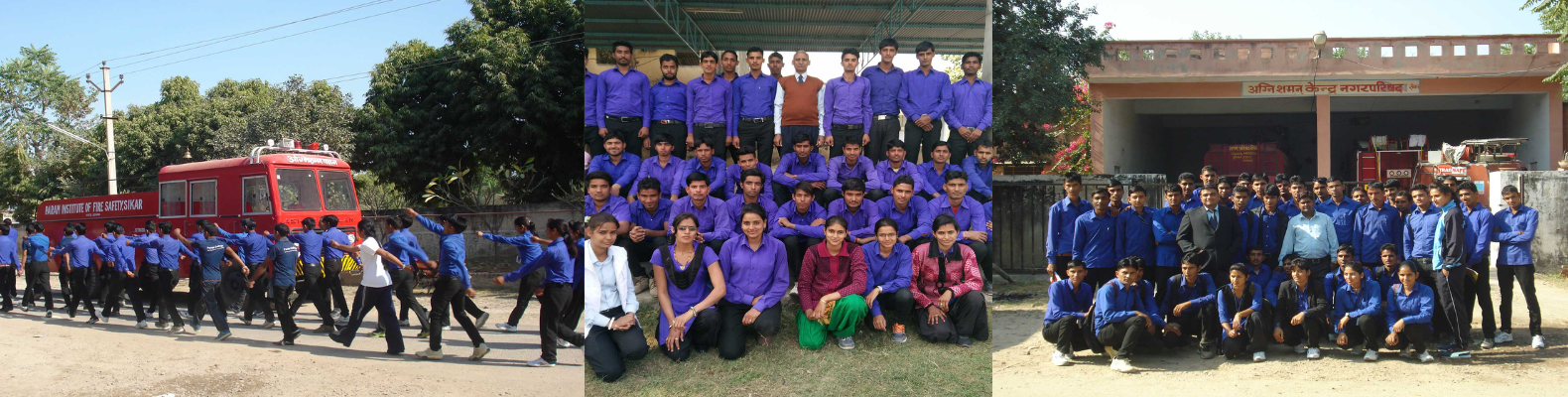
Fire Technology and Industrial Safety Management
Fire & Safety Management (Diploma/ITI)
During the one-year duration of “Fire Technology and Industrial Safety Management” trade a candidate is trained on professional skill, professional knowledge and Employability skill related to job role. In addition to this a candidate is entrusted to undertake project work, extracurricular activities and industrial visit to build up confidence.
The Fire Technology and Industrial Safety Management course will teach you all you need to know about firefighting, disaster management, workplace safety, and managing industrial risks. This curriculum teaches students how to plan for emergencies, deal with dangerous materials, avoid fires, and work safely in both public and industrial settings.
As the need for safety officers and fire technicians grows in fields including oil and gas, manufacturing, construction, aviation, and shipping, this course is a great way for students who are interested in safety and disaster management to get started on their careers.
Fire & Safety Management General
The Directorate General of Training (DGT) under Ministry of Skill Development & Entrepreneurship offers a range of vocational training courses catering to the need of different sectors of economy/ Labour market. The vocational training programmes are delivered under the aegis of Directorate General of Training (DGT). Craftsman Training Scheme (CTS) with variants and Apprenticeship Training Scheme (ATS) are two pioneer schemes of DGT for strengthening vocational training.
‘Fire Technology and Industrial Safety Management’ trade under CTS is one of the popular courses delivered nationwide through network of ITIs. The course is of one-year duration. It mainly consists of Domain area and Core area. The Domain area (Trade Theory & Practical) imparts professional skills and knowledge, while Core area (Employability Skills) imparts requisite core skill & knowledge and life skills. After passing out the training programme, the trainee is being awarded National Trade Certificate (NTC) by DGT having worldwide recognition.
Candidates need broadly to demonstrate that they are able to:
- Read and interpret technical parameters/ documents, plan and organize work processes, identify necessary materials and tools;
- Perform task with due consideration to safety rules, accident prevention regulations and environmental protection stipulations;
- Apply professional skill, knowledge & employability skills while performing jobs.
- Document the technical parameters related to the task undertaken.
Progression Pathways
- Can join industry as Technician and will progress further as Senior Technician, Supervisor and can rise to the level of Manager.
- Can become Entrepreneur in the related field.
- Can join Apprenticeship programme in different types of industries leading to National Apprenticeship certificate (NAC).
- Can join Crafts Instructor Training Scheme (CITS) in the trade for becoming instructor in ITIs.
- Can join Advanced Diploma (Vocational) courses under DGT as applicable.
Courses Structure
Table below depicts the distribution of training hours across various course elements during a period of one year: -
| S No. | Course Element | Notional Training Hours |
|---|---|---|
| 1 | Professional Skill (Trade Practical) | 840 |
| 2 | Professional Knowledge (Trade Theory) | 240 |
| 3 | Employability Skills | 120 |
| Total | 1200 |
Every year 150 hours of mandatory OJT (On the Job Training) at nearby industry, wherever not available then group project is mandatory.
| On the Job Training (OJT)/ Group Project | 150 |
| Optional Courses (10th/ 12th class certificate along with ITI certification or add on short term courses) | 240 |
Trainees of one-year or two-year trade can also opt for optional courses of up to 240 hours in each year for 10th/ 12th class certificate along with ITI certification, or, add on short term courses.
Eligibility & Course Details
| Details | Information |
|---|---|
| Eligibility | 10th / 12th Pass (Science preferred) |
| Course Duration | 1 – 3 Years (Diploma / ITI / Advanced Diploma) |
| Admission Process | Merit-based / Entrance test |
| Mode of Study | Regular with field training |
| Age Limit | 14 – 28 years |
Assessment & Certification
The trainee will be tested for his skill, knowledge and attitude during the period of course through formative assessment and at the end of the training programme through summative assessment as notified by the DGT from time to time.
The Continuous Assessment (Internal) during the period of training will be done by Formative Assessment Method by testing for assessment criteria listed against learning outcomes. The training institute has to maintain an individual trainee portfolio as detailed in assessment guideline.
The final assessment will be in the form of summative assessment. The All India Trade Test for awarding NTC will be conducted by Controller of examinations, DGT as per the guidelines.
The pattern and marking structure are being notified by DGT from time to time. The learning outcome and assessment criteria will be the basis for setting question papers for final assessment. The examiner during final examination will also check the individual trainee’s profile as detailed in assessment guideline before giving marks for practical examination.
Faculty & Training
Students learn how to:
- Trainers and fire officers that are certified
- People who work in disaster management
- Experts in health and safety
- Engineers who work on safety in factories
Training involves doing exercises, visiting factories, doing fire drills, learning how to use safety equipment, and doing rescue operations.
Career Scope After Course
Students can do the following after finishing this course:
- Work for the government or in industries' fire and safety divisions.
- You can work at oil refineries, airports, railroads, the military, shipping, and power plants.
- Be a Safety Officer, Fire Technician, Safety Engineer, or Risk Auditor.
- Get a higher degree, such a B.Sc. or M.Sc. in Fire and Safety, or get NEBOSH or OSHA certifications to open up more job options throughout the world.
Key Learning Areas
| Key Learning Areas | Details |
|---|---|
| Firefighting Techniques | Use of extinguishers, hoses, hydrants, rescue tools |
| Industrial Safety | Workplace safety, hazardous materials handling |
| Disaster Management | Emergency planning, evacuation procedures |
| Safety Laws & Regulations | National and international safety standards |
| Risk Assessment | Identifying and controlling industrial hazards |
| Communication & Leadership | Safety audits, reporting, team management |
Course Syllabus (Overview)
| Semester | Major Subjects |
|---|---|
| Semester 1 | Basics of Fire Technology, Fire Chemistry, First Aid |
| Semester 2 | Fire Equipment & Appliances, Industrial Hazards |
| Semester 3 | Disaster Management, Occupational Health & Safety |
| Semester 4 | Risk Assessment, Safety Laws, Project & Internship |
Career Options After Completing Course
- Fire Officer / Fireman
- Industrial Safety Officer
- Fire & Safety Supervisor
- Disaster Management Specialist
- Safety Engineer in Industries
- Consultant in Fire & Safety Audits
Certifications & Additional Training
- Diploma in Industrial Safety
- NEBOSH (International Safety Certification)
- OSHA Safety Training (USA Standard)
- First Aid & CPR Certification
- Disaster Management Training
Internship & Hands-on Training
- Fire Station & Disaster Control Unit visits
- Industrial safety training in factories & plants
- Mock drills for fire & evacuation
- Safety audits & inspection projects
FAQs: Fire & Safety Management
Q1. Who is eligible for the Fire & Safety Management course?
Individuals who have studied up to the 10th or 12th class from any recognized board are eligible for admission to the Fire Technology & Industrial Safety Management course. Preference will be given to students who have pursued science streams as their subjects.
Q2. What is the duration of the Fire & Safety course?
The course duration varies between 1 year for ITI or diploma courses and 2-3 years for advanced diploma and degree courses in Fire & Safety Management.
Q3. Is it possible to work in a government department after taking the Fire & Safety course?
Certainly, students who have completed the Fire & Safety course through ITI can apply for posts in fire departments, railways, airports, municipal corporations, defense services, industries, and government industrial safety departments.
Q4. What is the salary after taking the Fire & Safety course?
Salary after completing the Fire & Safety course depends on the experience and qualifications of candidates. On average, freshers working in this field receive ₹15,000-₹30,000 per month, while experienced individuals receive much higher pay in both Indian and foreign companies.
Q5. Can I work abroad once the course on Fire & Safety Management is completed?
Fire & Safety management professionals are in huge demand in oil & gas sector, construction firms, aviation, ships, manufacturing industries, and other industrial establishments throughout the globe. Possessing international certifications like NEBOSH or OSHA makes it even better.

